


What is Montessori?

Montessori was developed by the Italian physician, educator, and innovator Dr. Maria Montessori. She is acclaimed for her educational method, which builds on the way children learn naturally. It is a scientifically based education approach that fosters independence, learning at their own pace, and freedom within limits.
Maria Montessori believed that each child are born unique with immense potential who's driven with curiosity, always want to explore, learn, and be engaged. In Montessori, the teacher need to guide each child through the learning processusing materials and curriculum that fit their specific needs and pace.
Five Learning Areas in Montessori

Practical Life
Practical life is a core element of the Montessori philosophy; it is the foundation for all subsequent themes in a Montessori education. It is divided into four main aspects: pragmatically interrelated skill sets. Preliminary activities, care of self, care of environment and grace and courtesy are the main aspects and independence, body coordination and control, concentration, and sense of order are the objectives of practical life activities. First, the child is introduced to an environment that is logically ordered, and a clear incremental increase in the difficulty of tasks is apparent and welcomes the child. The main goals are cooperation and taking responsibility to achieve outcomes.
Sensorial
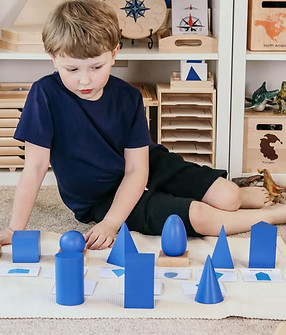
The sensorial curriculum holds a significant place in Montessori methodology. It focuses on lessons and activities that help the child develop the stereognostic senses: hearing, touching, seeing, tasting, and smelling. Before the children were introduced to the language arts and mathematics, they worked to refine their senses first. The Montessori sensorial education involves the refinement of the child's senses through the repeated manipulation of specifically designed materials. While the child is refining his senses, he is also developing his concentration, his sense of order, and, ultimately, his intellect.

Mathematics
Before learning Montessori mathematics, in the early childhood environment, the preparation for mathematics occurs across all the Montessori curriculum areas. From practical life to sensorial, from culture and science to language, working on activities in these areas indirectly lays the foundation for the child's work in mathematics. In the Montessori early childhood program, the child is consistently encouraged to explore concepts and strengthen abilities in order to fully support the math-related sensitive periods that the child experiences during the early childhood years. Montessori math materials incorporate order, precision, exactness, and orientation in their design.

Language Arts
Montessori language arts are unique in their multi-sensory approach. Children are encouraged to use their stereognostic senses, touch, sight, and sound, to learn language. This approach makes learning more engaging and enhances the child's understanding and retention of language skills. The Montessori language area focuses on early-literacy skills through the use of phonetic sounds. The lessons and activities are designed to improve a child's vocabulary, listening skills for familiar sounds, and ability to differentiate between objects and pictures. Children are taught to read by learning the sounds of letters and then blending those sounds together to form words.

Culture and Science
The culture and science in Montessori schools encourage preschoolers to explore and discover the history of past and present cultures and our living planet. The culture and science curriculum allows the child to quest to understand the world and learn about people with different cultural backgrounds and languages. The students will learn about geography, one field through which children study the human culture, biology, zoology, music and arts through hands-on learning.